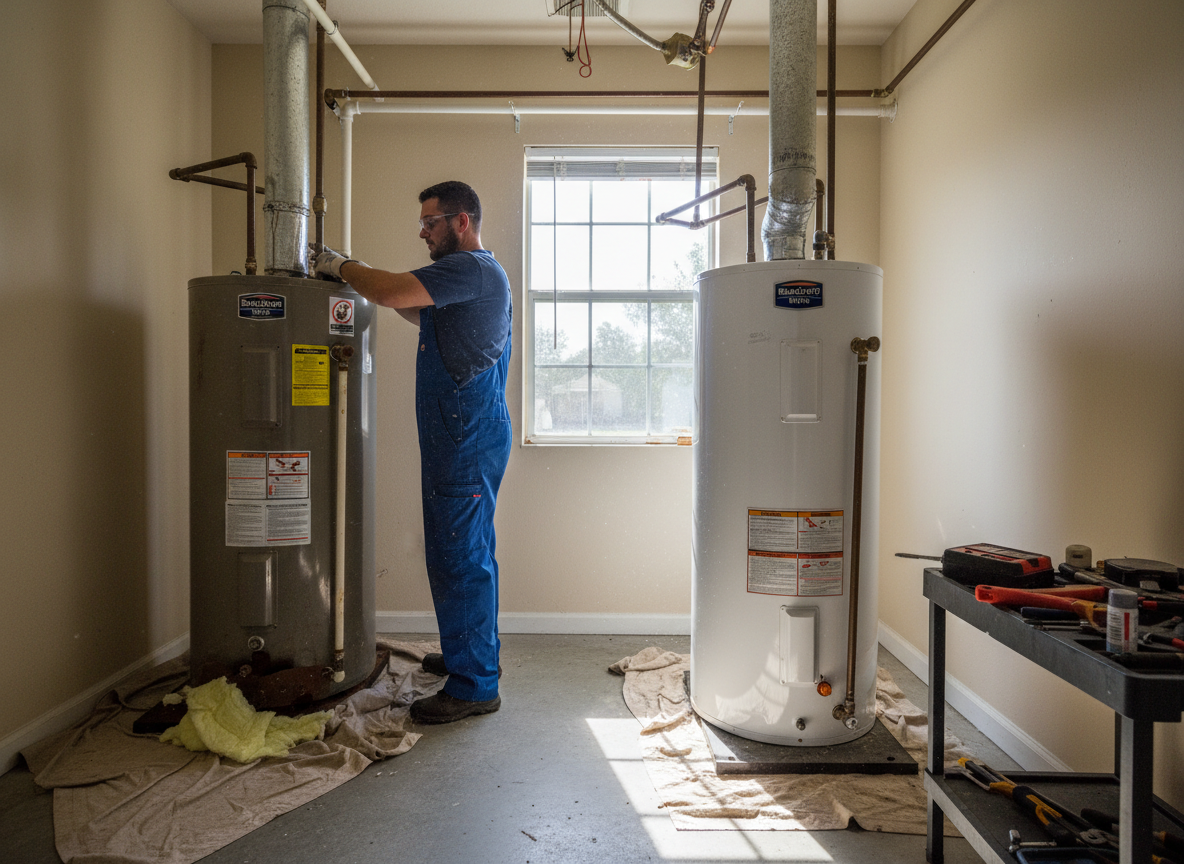
Palm Coast homes built from the 1970s onward in neighborhoods like Palm Harbor and Indian Trails often rely on 40- or 50-gallon tank units tucked in garages or utility closets. The region's humid subtropical conditions with hot summers speed up external corrosion on older steel tanks, especially where air conditioning condensate drips nearby or ventilation stays limited. Replacement jobs here routinely involve checking the existing venting path to the roof, confirming it meets current Flagler County mechanical code, and verifying the T&P relief valve discharge line routes safely outside.
Mild winters keep water heaters running year-round without freeze protection worries, yet the constant humidity still promotes mineral scale on heating elements in electric units common throughout Matanzas Woods. When swapping units, technicians must account for the slab-on-grade construction typical in these subdivisions, which means tight access for maneuvering new tanks and sometimes requires temporary removal of closet doors or water heater stands. Proper dielectric unions on copper lines prevent future galvanic corrosion, a detail that matters more in coastal Flagler County than inland areas.
Nearby influences from Daytona Beach and St. Augustine mean many Palm Coast residents compare quotes across county lines, but local plumbers know the Flagler permitting process and inspection schedules best. Replacement also includes flushing sediment that builds faster in the area's groundwater, which carries higher dissolved solids than many expect. Skipping this step shortens the life of the new unit even when the install itself is flawless.
Technician insight
In Palm Coast, the thing that catches most people out with Water Heater Replacement is how quickly condensation in our humid subtropical summers eats through tanks in 1980s-era homes in Indian Trails and Palm Harbor. Homeowners often skip checking the roof vent termination, which then fails inspection and adds days to the job.
Matanzas Woods Tank Failure
A homeowner noticed rusty water from taps in a 1987 single-story home. Inspection revealed heavy external corrosion on the electric tank caused by poor garage ventilation. The old unit was removed, a new 50-gallon model installed with updated venting and dielectric unions, and the system passed Flagler County inspection the next day.
How it works
- 1
Site Assessment
Inspect current heater location, venting, gas or electric supply, and water lines in the specific home layout.
- 2
Unit Selection and Permitting
Match capacity and fuel type to household needs, then pull required Flagler County permits before work begins.
- 3
Old Unit Removal
Safely disconnect, drain, and haul away the existing tank while protecting flooring and nearby finishes.
- 4
New Installation and Testing
Set new heater, connect lines with dielectric unions, restore venting, fill, and test for leaks and proper operation.
Pricing
Upfront quotes after on-site inspection; cost varies with tank size, fuel type, and access conditions in Palm Coast homes.